Skip to content
If your water leaves orange stains in the sink, smells like rotten eggs, or turns cloudy after a rainstorm, you are not dealing with one simple problem. That is why homeowners ask, how does a well water filtration system work, and why does one house need a different setup than the next? The short answer is that a well water system treats the specific contaminants in your water in a set order, so each stage handles one job well instead of asking one tank to fix everything.
That order matters more than most people realize. Well water is not treated by a city before it gets to your home, so the system installed at your property is doing the heavy lifting. A proper setup can remove grit, reduce staining minerals, kill bacteria, improve taste, and protect plumbing and appliances. A poor setup might help one issue while leaving the bigger one untouched.
Table of Contents
ToggleHow does a well water filtration system work in a home?
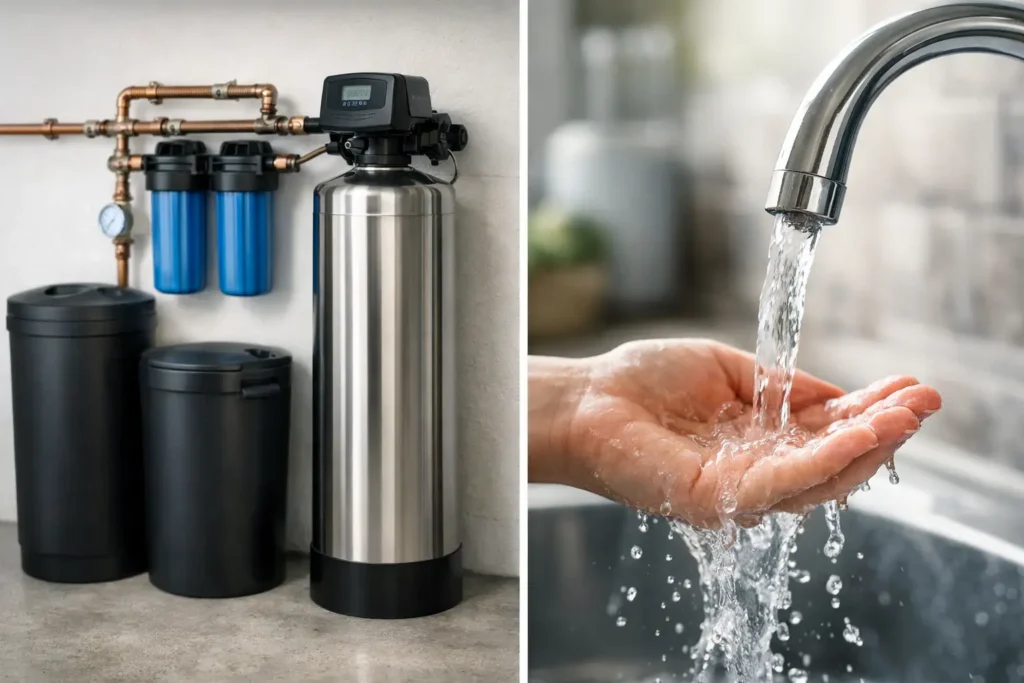
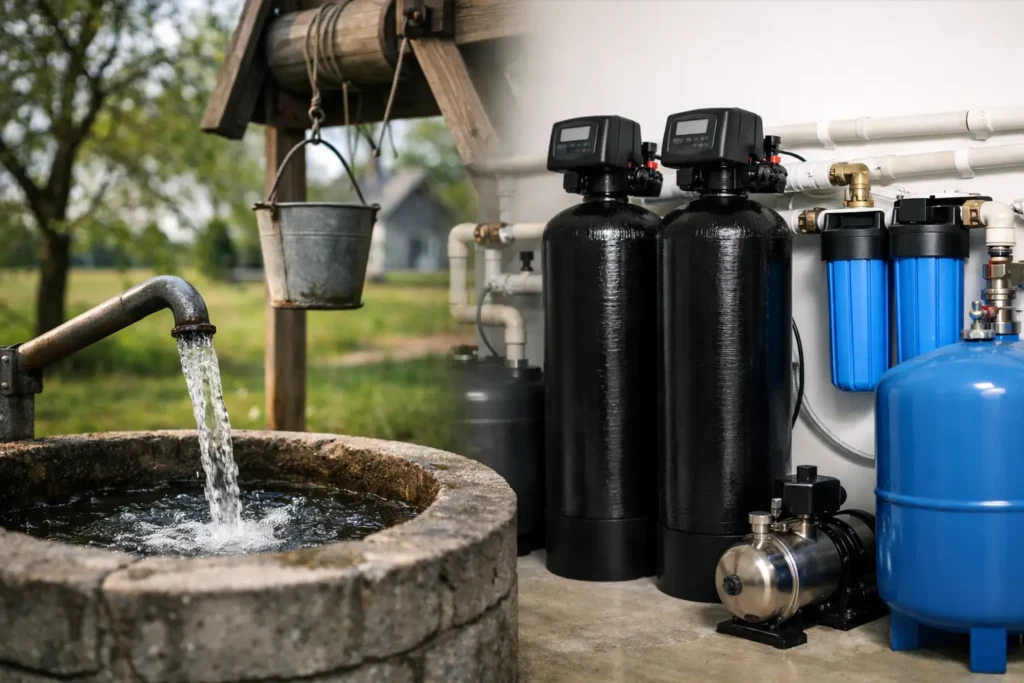
A well water filtration system works by moving water through multiple treatment stages after it enters the house from the well pump and pressure tank. As water flows through the system, each stage targets a specific issue such as sediment, iron, manganese, sulfur odor, hardness, or microorganisms.
In most homes, the process starts with basic screening. Sediment filters catch sand, silt, rust, and debris before those particles can clog valves or damage more specialized equipment. If your water contains visible grit, this first step is essential. It protects everything that comes after it.
Next comes treatment for dissolved contaminants. This is where the system can vary quite a bit. Some homes need an iron filter with air injection or catalytic media. Others need a water softener to remove hardness minerals like calcium and magnesium. Some need both, because hard well water and iron often show up together.
After that, many systems add a disinfection stage or a polishing stage. UV systems are common when bacteria risk is a concern. Carbon filtration may be used to improve taste, reduce odors, or address certain organic compounds. Reverse osmosis is usually installed at the kitchen sink for drinking water rather than for the whole house, because it treats water slowly and very thoroughly.
The goal is simple: build a system around the water test, not around guesswork.
The main parts of a well water filtration system
A complete well water setup usually includes more than one piece of equipment, even if people casually call it a single filter. Each part plays a different role.
Sediment filtration
Sediment filtration removes physical particles from the water. That includes sand, dirt, rust flakes, and fine silt. In some wells, sediment is light and occasional. In others, especially after pump work or seasonal changes, it can be constant.
This stage often uses a cartridge filter, spin-down filter, or backwashing media filter. The best choice depends on particle size and how much sediment your well produces. Cartridge filters are common, but if your well carries a heavy sediment load, replacing cartridges too often gets expensive and frustrating.
Iron and manganese treatment
Iron causes orange or brown staining on sinks, tubs, and laundry. Manganese tends to create black or dark brown staining and can give water a metallic taste. Both can build up inside plumbing and fixtures.
These contaminants are usually treated with an oxidizing filter. Some systems inject air into the water, which helps convert dissolved iron into particles that can be filtered out. Others use chemical injection or specialty filter media. What works best depends on whether the iron is ferric, ferrous, or mixed, and whether manganese is present too.
This is a good example of why water testing matters. The wrong iron filter can underperform, while the right one can solve staining with very little day-to-day attention.
Sulfur odor treatment
If your water smells like rotten eggs, hydrogen sulfide gas is often the cause. That smell may be strongest in hot water, or throughout the whole house.
Sulfur odor is often treated with air injection, oxidizing media, carbon filtration, or a combination of those methods. If sulfur is present along with iron and manganese, the system needs to be designed to handle all three together. Treating just the odor without dealing with the companion contaminants usually leads to disappointing results.
Water softening
Many well owners also need a water softener. Hard water causes scale buildup in water heaters, dishwashers, faucets, and pipes. It also makes soap less effective, which can leave skin feeling dry and dishes looking spotted.
A softener works through ion exchange. As hard water passes through resin beads, calcium and magnesium are removed and replaced with sodium or potassium. The softener then regenerates on a schedule, flushing those minerals away with brine.
Not every filter removes hardness, and not every softener handles iron well. Some units can manage a small amount of iron, but if iron levels are high, it is usually better to remove iron before the softener. That helps the softener last longer and perform better.
UV disinfection
If a water test shows coliform bacteria, E. coli risk, or ongoing microbial concern, UV treatment is often part of the solution. A UV system exposes flowing water to ultraviolet light that damages microorganisms so they cannot reproduce.
UV works well, but it has one big condition: the water must be clear enough for the light to do its job. If sediment, iron, or cloudiness are not handled first, UV performance drops. That is why UV is usually installed after filtration rather than at the front of the system.
Drinking water reverse osmosis
For families who want better-tasting water at the tap, reverse osmosis is often added as a point-of-use system under the kitchen sink. RO pushes water through a semipermeable membrane to reduce dissolved solids, salts, metals, and other fine contaminants.
It is not usually the first tool used to fix whole-house well water issues. It is better thought of as a final drinking water upgrade after the house-wide problems have already been addressed.
Why the treatment order matters
The biggest mistake homeowners make is assuming all contaminants can be treated in any order. They cannot. If sediment reaches a softener, it can foul the resin. If iron reaches a UV system without proper pretreatment, it can block the light. If sulfur and iron are both present, a basic carbon filter may not be enough.
A good system is built like a chain. Each stage protects the next one and makes it more effective. A common setup might go from sediment filtration to iron or sulfur treatment, then to softening, then to UV, and finally to reverse osmosis at the kitchen sink.
That does not mean every home needs all of those stages. Some wells only need sediment and softening. Others need a much more specialized package. The point is that the correct sequence matters just as much as the equipment itself.
What determines the right well water system?
The answer depends on your water chemistry, your household size, and your flow needs. Two neighboring properties can have different well depths, different mineral content, and different contamination risks.
Water testing is the starting point. A proper test can reveal hardness, pH, iron, manganese, sulfur, tannins, bacteria, total dissolved solids, and more. Without that information, buying a system is mostly guesswork.
Usage also matters. A larger family with multiple bathrooms needs equipment sized for higher flow rates and more frequent demand. A home with low flow or intermittent use may need a different setup to avoid stagnation or maintenance issues.
Then there is the question of convenience. Some systems need regular cartridge changes. Others backwash automatically. Some need salt. Others do not. The best setup is not only the one that treats the water correctly, but the one you will realistically maintain.
Common signs your well water needs more than a basic filter
If your water has staining, odor, slime buildup, scale, cloudy appearance, or a bad taste, a simple off-the-shelf filter is usually not enough. The same goes for recurring appliance issues, low soap performance, or concerns after a failed bacteria test.
This is where a customized, installed system makes more sense than piecing together random components. Companies like Water Softener Red Deer typically start with testing, then match the equipment to the actual water profile and install it in the correct order. That saves homeowners from paying twice – once for the wrong fix, and again for the right one.
Maintenance is part of how the system works
A well water filtration system is not a set-it-and-forget-it product forever. It works properly when the media, lamps, valves, and filters are maintained on schedule.
That might mean adding salt to a softener, replacing sediment cartridges, changing a UV lamp each year, sanitizing components, or checking backwash settings. The exact maintenance depends on the equipment you have and how challenging your water is.
The good news is that a correctly sized system usually makes maintenance predictable. The bad news is that an undersized or mismatched system tends to become a constant headache. If you want cleaner water without babysitting the equipment, proper design at the start matters a lot.
The best well water system is not the one with the most tanks. It is the one that solves the actual problems in your water, protects your home, and fits how your household uses water every day. If your well water has been leaving clues around the house, those clues are usually enough to tell you it is time for testing and a system built for your property, not for someone else’s.