Skip to content
If your well water leaves orange stains in the tub, white buildup on faucets, or makes soap feel like it never quite rinses off, you are probably asking the right question: what does a water softener do for well water? The short answer is that it removes hardness minerals, mainly calcium and magnesium, so your water is easier on plumbing, fixtures, appliances, skin, and laundry. The longer answer matters more, because well water often brings more than just hardness.
A lot of homeowners assume a softener is a complete fix for every well water problem. Sometimes it is a big part of the solution. Sometimes it is only one part. That difference is where good water testing saves people money, frustration, and repeat service calls.
Table of Contents
ToggleWhat does a water softener do for well water in a home?
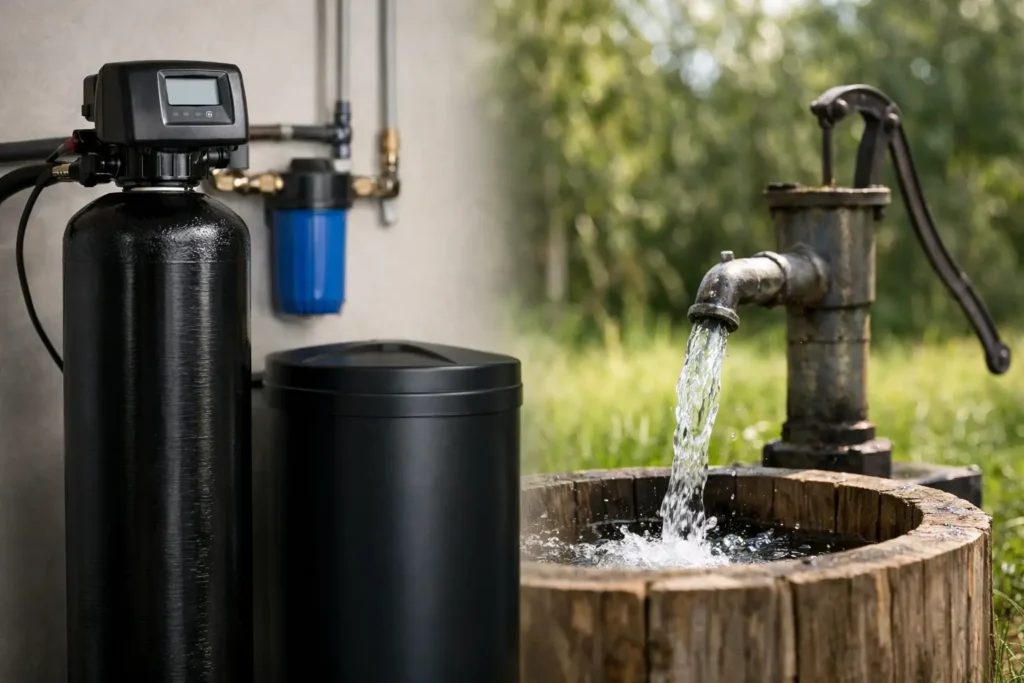
A water softener is built to treat hard water. In most homes, that means it uses ion exchange to remove calcium and magnesium from the water before that water moves through your plumbing system. Those minerals are what create scale on fixtures, reduce soap performance, and slowly wear down water heaters, dishwashers, washing machines, and other water-using equipment.
When well water is hard, a softener helps in very practical ways. Soap lathers better. Dishes come out cleaner. Towels feel less stiff. You use less detergent, less shampoo, and less cleaning product to get the same result. You also reduce mineral scale inside pipes and appliances, which can help equipment run more efficiently and last longer.
For many rural properties, that alone makes a softener worth it. Hard well water is hard on a house. If you have ever replaced heating elements early, cleaned crust off showerheads, or fought cloudy glassware that never looks fully clean, you have seen the effects firsthand.
What a water softener does not do for well water
This is the part that gets missed most often. A water softener does not solve every well water issue.
If your water has iron, manganese, sulfur odor, sediment, tannins, bacteria, or other contamination, a softener may help with some of it under certain conditions, but it is not a cure-all. In fact, the wrong setup can make a system work poorly or create more maintenance than expected.
For example, many well owners notice rotten egg odor and assume a softener will fix it. Usually, sulfur odor needs a different treatment approach. The same goes for cloudy water caused by sediment, or bacteria concerns that require disinfection such as UV treatment. A softener also does not function like a drinking water purifier. If you want cleaner drinking water at the kitchen sink, that often calls for reverse osmosis or another dedicated filtration system.
That is why the best answer to what does a water softener do for well water is this: it solves hardness, and it may be part of a larger well water treatment package when other issues are present.
Common well water problems that may need more than a softener
Well water varies from one property to the next, even within the same area. One home may only have hard water. The next may have hardness plus iron and sulfur. Another may have sediment and bacteria concerns after spring runoff or changes in the well.
Iron is a common example. If it is present at low levels, some softeners can remove a limited amount of clear water iron. But if iron is high, or if it is the kind that causes strong staining and fouling, you usually need an iron filter ahead of the softener. Without that, the resin bed inside the softener can get loaded up with iron and lose efficiency.
Manganese creates dark staining and can be even trickier. Sulfur odor usually needs oxidation or specialized filtration. Sediment needs a pre-filter so grit does not clog valves or damage equipment. Bacteria concerns need a system designed for disinfection, not just conditioning.
This is where a proper test matters. You do not want to buy a softener for a problem that is actually being caused by something else in the water.
Signs your well water may benefit from a softener
Most homeowners do not measure hardness first. They notice symptoms.
Your well water may need softening if you see white scale on faucets, chalky residue in kettles, mineral spots on dishes, stiff laundry, dry skin after showers, or soap that feels hard to rinse away. Water heaters that seem to struggle, showerheads that clog, and fixtures that lose flow over time can also point to hardness.
If you are on a rural property and your home has never had a softener, or the current unit is older and not performing well, those symptoms are worth checking. Hardness can build slowly, so many families get used to the effects and only realize the difference after the water is treated properly.
How a softener fits into a complete well water setup
For well water, the best system is often staged in the right order.
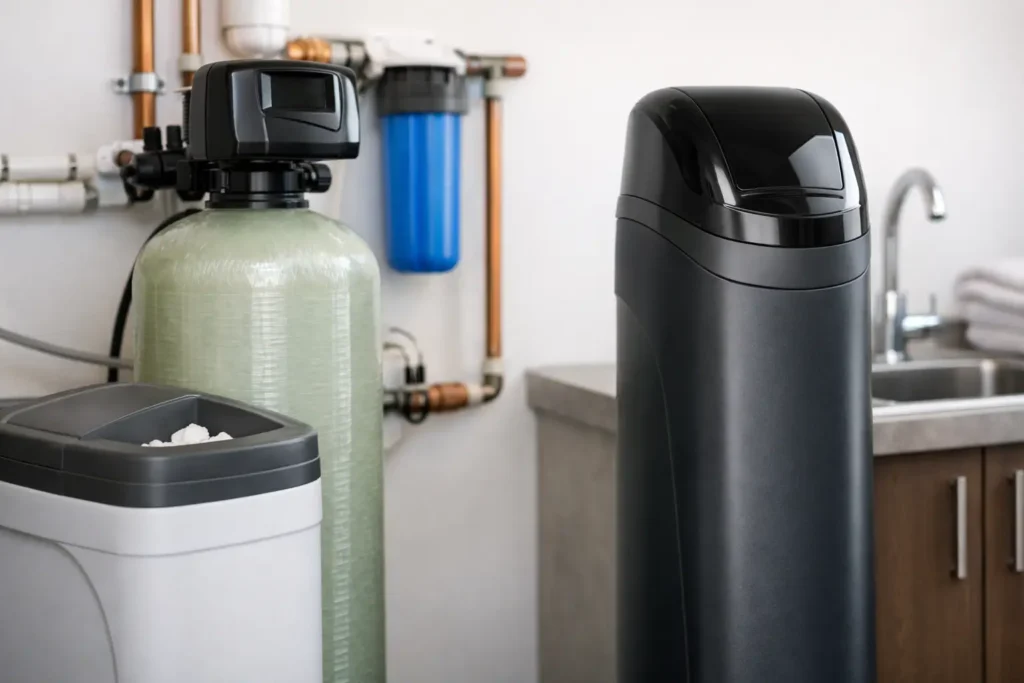
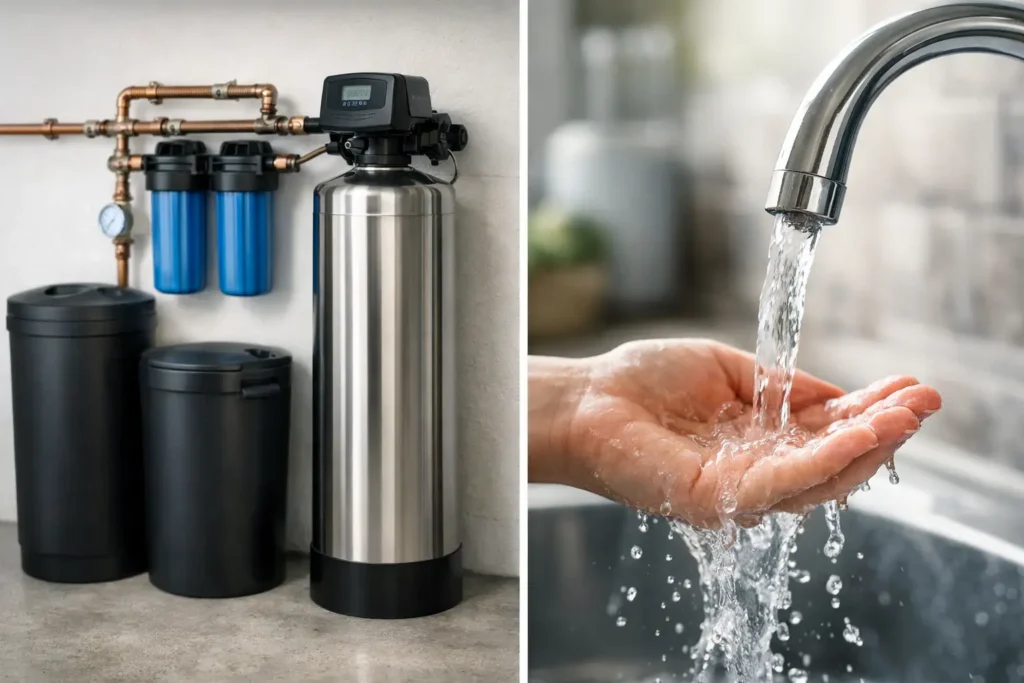
A sediment pre-filter may come first if the water carries sand, silt, or other particulate. If iron, sulfur, or manganese is present, a dedicated treatment tank may be added before the softener. The softener then handles hardness. If bacteria is a concern, UV disinfection is usually installed after filtration so the light can work effectively. For drinking water, a reverse osmosis system may be added at the kitchen sink for better taste and lower dissolved solids.
That layered approach matters because each piece protects the next. A softener performs better when sediment and heavy iron are handled properly. UV performs better when the water is already clear. Reverse osmosis lasts longer when hardness is reduced first.
This is also why turnkey installation tends to work better than guessing your way through separate products. With well water, the right combination matters more than any single piece of equipment.
Salt-based softeners vs. other options for well water
If your main issue is true hardness, a traditional salt-based water softener is still the most effective option. It actually removes hardness minerals from the water. That is different from salt-free conditioners, which may reduce scale behavior in some cases but do not soften water in the same way.
For well water homes with noticeable hardness problems, most people want the real benefits of softened water, not a partial improvement. That usually means a properly sized salt-based unit with enough capacity for household demand and regeneration settings matched to actual water conditions.
Sizing is important. A unit that is too small will regenerate too often and wear out faster. One that is oversized or programmed poorly may waste salt and water. The right setup depends on hardness level, family size, water use, iron content, and flow rate needs.
Is a water softener enough for your well water?
Sometimes yes. If testing shows your well water is mainly hard and otherwise clean, a softener may be exactly what you need.
Sometimes no. If your water has hardness plus iron staining, odor, sediment, or bacteria risk, the softener should be one part of a broader treatment plan. That is not overcomplicating the process. It is how you avoid buying twice.
For homeowners around Red Deer, this is especially relevant because local water conditions can vary quite a bit between properties. A neighbor’s setup may not be the right fit for your well, even if the symptoms look similar at first.
The most cost-effective approach is usually to test first, then match the equipment to the actual water profile. That keeps the quote honest, the installation straightforward, and the system performance predictable.
The real value of softening well water
A water softener does more than make water feel nicer. It protects the expensive parts of your home that rely on water every day. It cuts down on scale, reduces cleaning effort, improves soap performance, and helps appliances work under less stress.
For well water homes, those benefits are real, but the bigger win is getting the whole system right. If your water needs only softening, keep it simple. If it needs softening plus filtration or UV, build the system around the full picture. Water Softener Red Deer sees this every day with rural properties – the best results come from treating the actual problem, not just the most obvious symptom.
If your well water has been leaving clues around the house, the smartest next step is not guessing. It is finding out what is in the water and choosing a setup that fixes it for good.